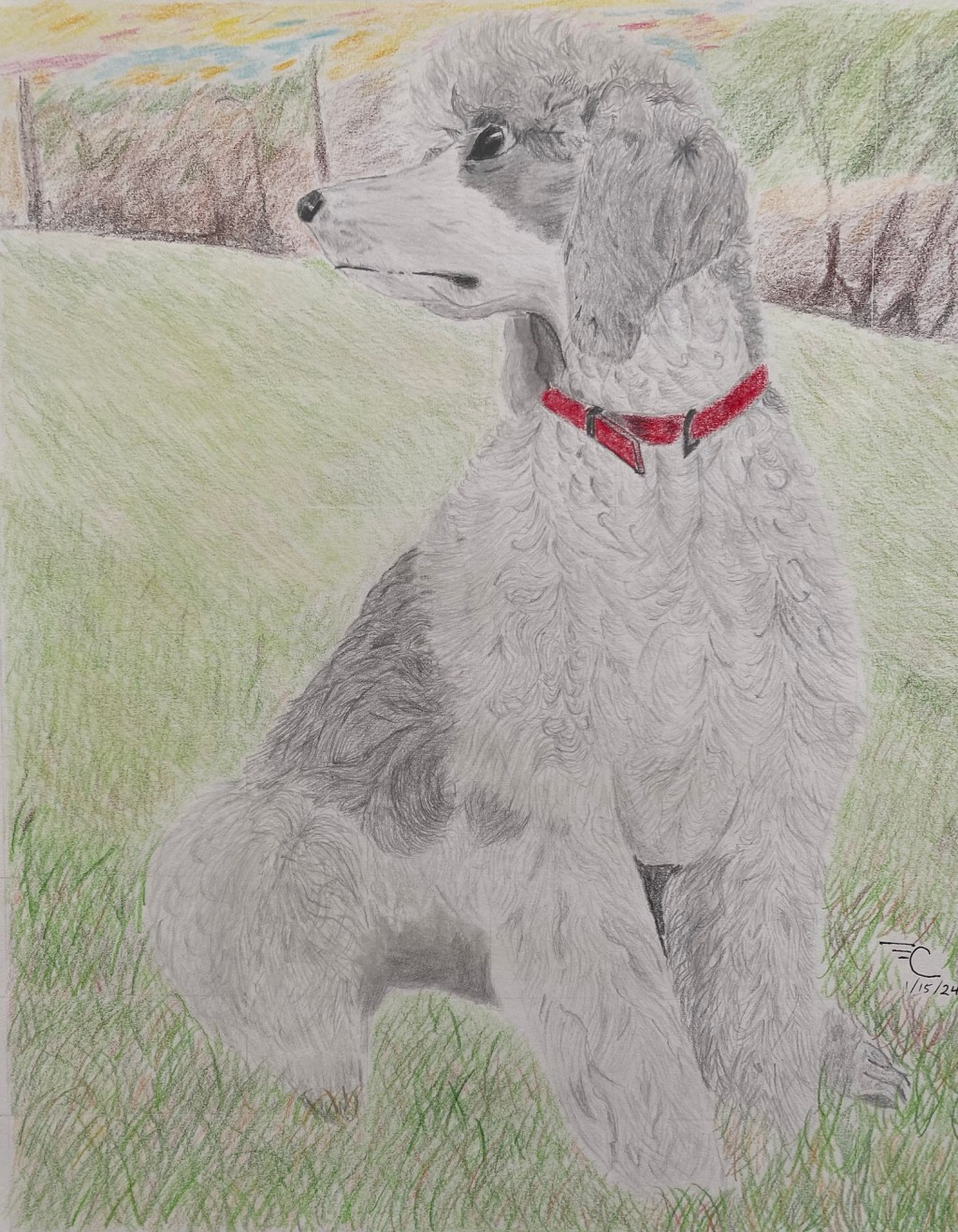
So we got this dog a couple of months ago, Bruce; he’s a standard poodle. He’s been a great addition to the family so far; he’s smart, fun, silly, happy, very trainable, he’s great with people, he’s very healthy, and the fact that he is a non-shedding breed is a nice bonus. But, Bruce has a little problem. Bruce is what is known as a ‘parti’ poodle, which refers to his color. A parti poodle is defined as having a coat that is 50% or more white, and the remainder can be any combination of other colors, Bruce being white and various shades of apricot. Before we adopted Bruce, we were told by the breeder that because of his coloring, Bruce could be registered as an AKC purebred poodle, but he would not be eligible to be a show dog, since parti colors are considered a flaw under AKC conformation standards. Poor Bruce. But, since we never intended to adopt a show dog in the first place, his so-called flawed coat was not a big concern for us. In fact, we all agreed that his colors were quite handsome. At the same time, this AKC color standard got me thinking about standards. Why are those color standards in place? Who cares what color they are?
In aviation, we talk about standards a lot. For pilots, standards are a critical part of how we execute our flights, because they define the roles and responsibilities of crew members, and they also define how most normal flight tasks are to be accomplished. At an airline as large as the one I work at, this is a very good thing, especially when one considers that we have around 15,000 pilots, so I’ll often go a year or more without flying with the same pilot twice. Because of our standards, we arrive to work having a common understanding of how the flight will be conducted. Like many sectors of society, aviation has many different sets of standards applicable to its various facets: standards for aircraft construction and safety, standards for pilot qualification, standards for airports, and so on.
In my day-to-day work existence, I find our flight standards to be particularly helpful in several ways. The first is, as already mentioned, the shared understanding of roles and responsibilities for each crew member. The second is as a catalyst for conversation. For example, there are occasions when I may want to utilize aircraft automation in a way that is a little different than what is written in our standards. That is my prerogative as the captain, but at the same time, if I or the other pilot is doing something that is non-standard, we now have a responsibility to discuss that with the other pilot. This is, of course, a good thing; it goes without saying that things can go bad quickly if one pilot doesn’t know what the other is doing. The third way that standards are helpful is as a barrier against errors. This is especially true when a situation arises that is out of the ordinary; if there is some kind of problem with the aircraft, for example, we have standards to follow that help point us to the correct procedures and resources.
I suppose where things might get a little tricky is, what happens when there is a standard that one doesn’t agree with? This probably happens to most people within their area of expertise from time to time. It certainly does for me; we have a few standards at the airline that I would change if it were up to me in a vacuum. At the same time, my airline has been in operation for a long time, and has good reasons for doing things the way they do. So, unless it is something that I feel is unsafe, I’ll follow the standards that are in place, while making suggestions for potential improvements or refinements when I have appropriate opportunities. In the past, perhaps I haven’t thought about our flying standards as much as I should have; I have generally just followed them, and have occasionally tried to effect change where I thought it was needed. For the most part, though, the standards we operate by as pilots certainly make our jobseasier, safer, and more efficient.
Getting back to Bruce, I have yet to find a completely satisfactory answer as to why his coloring is prohibited by AKC conformation standards. In my (admittedly brief) research on the topic, the short answer seems to be that the prohibition is driven in part by genetic factors and and in part by tradition, both aspects being concerned with maintaining the overall health and integrity of the breed. Fair enough, I suppose. Personally, I don’t see why parti colors would make Bruce any less of a poodle than one with solid colors, but I honestly don’t care all that much, either. Bruce is great just the way he is. At the same time, I can appreciate and respect the standards that are in place to formally define what makes a poodle, well, a poodle. No matter how one feels about purebred vs. non-purebred pets (I’ve had both), a standard that exists to encourage careful and ethical breeding is an unqualified good thing, even if one might not agree with a few of the particulars. We could say something similar for many areas of life; standards silently help to keep most sectors of society moving, from education to manufacturing to emergency services to, yes, that airplane you board to go on vacation. Considered this way, it seems like the many standards around us are more than just sets of instructions and expectations; they are collections of gathered wisdom that help us live better, safer, and more efficiently. Which I am all in favor of – even if it means I can’t hit the show circuit with Bruce ;).
AB23
 Afterburnings