
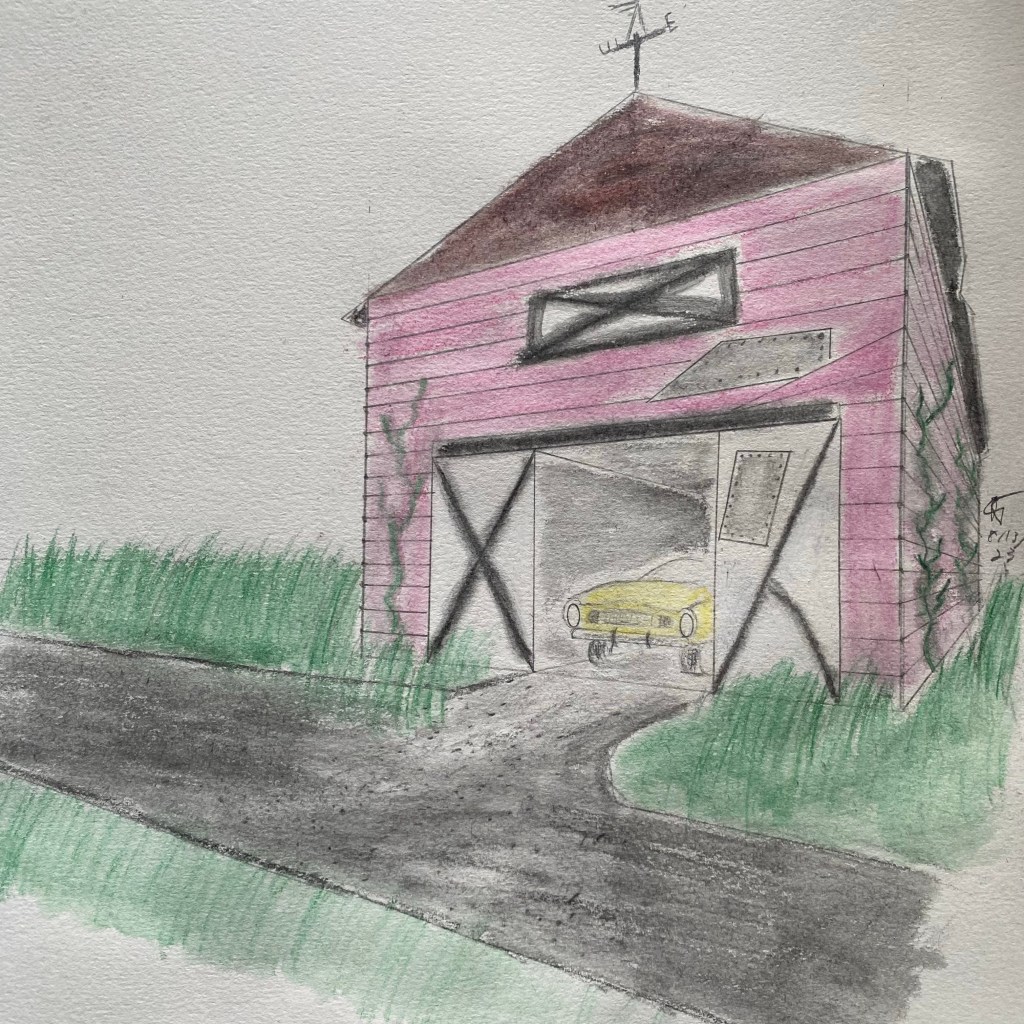
I recently started volunteering at a local automotive museum for a couple of hours per week. It’s a very nice facility, and it has a wide variety of interesting vehicles for anyone (like me!) who is interested in that sort of thing. On the days that I typically go, the main tasks for the volunteers are twofold: the first is moving cars around to accommodate different events, to rearrange exhibits, or for maintenance or storage. After all of the moving and staging is done, the second task begins – polishing the cars exhibited on the museum floor.
When I arrived at the museum this past week, I joined a group of volunteers who were tasked with moving about ten cars around in order to rearrange a section of exhibits. The museum is a “working” museum, which means that, with some exceptions, all of the cars at the museum are in running and driving condition, despite the fact that many of them are quite old. In fact, museum personnel regularly drive cars from the exhibits to be displayed at various local events and car shows during the summer. With that in mind, we opened two large garage doors at the rear of the building and set out to get the cars moved. The way that the cars were laid out, we could simply start them and drive them out of the building, and then back them in again in the correct order. On this day, however, the cars had other ideas. The first one refused to start. The second one refused to start. The third had a dead battery. The brakes were stuck on the next one. Another was leaking oil on to the museum floor. And so on. To make a long story short, we ended up just putting all of the cars in neutral and pushed them where they needed to go, which was easy enough, since there were plenty of people around to help out.
What happened next, though, was what made the episode notable. The mood among the volunteers, which was already good and positive, seemed to improve even more when faced with these cantankerous and uncooperative cars. The volunteers were smiling, laughing, and shaking their heads as they pitched in to push or steer the cars, some reminiscing about mechanical problems or challenges, special road trips, or just little quirks they experienced with their own special cars. In a way, it seemed like the difficult and imperfect nature of these old cars made them more endearing.
As we moved on to polishing the vehicles, we split up into different areas of the museum, and I found myself working on a couple of old pickups, a Willys Jeep, and a Corvette. If one was to walk through the museum just as a visitor to look at the cars, one would likely be impressed with both the variety and the excellent condition of the cars. Polishing them, though, changed my perspective. Slowing down and focusing on the small details of the cars, I began to notice the little imperfections of the cars that one would likely miss without close inspection. A paint chip here, a crack in the gloss there, a slight misalignment of body panels here, a separated upholstery seam there, a minor clouding of glass here, a scratched rim there. Like the cars that wouldn’t start, however, it seemed like the little flaws and asymmetries only made the cars more interesting. I wondered about their stories – the miles they had been driven, the roads they had been driven on, and the human narratives of which they were a part.
When I left the museum a few hours later, I needed to stop at a store for a few necessities. When I got there, I was struck by the contrast between the experience of the museum and the messages of media, advertising, and society I was experiencing outside of it. People and objects on billboards and advertisements were photoshopped to precise digital symmetry and perfection, and a constant fire-hose of information, flashing advertisements and noise seemed to be some sort of obtuse contest to see how much content and stimulation could be jammed into each corner and moment of existence, in an attempt to compete for consumers’ attention and dollars. And if that wasn’t enough, few if any of the shoppers could actually be bothered to look where they were going, as they seemingly couldn’t look up from their devices long enough to consider their environment. It all seemed exhausting to me, so I got what I needed and got out of there as quickly as I could. Why did this not seem to bother anyone else? How could a person slow down and appreciate the small things in such an environment?
When I got home to my (thankfully) quiet house, I revisited that question in my mind. Was I crazy? Was a desire for intention and deliberation in a world of TikTok and Twitter just the anachronistic ranting of an old man? You, dear reader, can be the judge of that. For me, though, as I sat in my favorite chair, I recalled an eastern idea that I had once read about called Wabi-Sabi. While there are many layers and nuances to Wabi-Sabi, an essential element of it is a mindful acceptance and appreciation of things that are uncluttered, temporary and imperfect; a cracked vase with a single flower, a piece of driftwood, a scattering of autumn leaves on the ground, a simple cup of tea in a handmade ceramic mug. Put another way, it is finding the beauty in things not in spite of imperfections and impermanence, but because of them.
With this idea in mind, I got up out of my chair and went out to the garage. Walking around my car, I saw a small scratch in a piece of exterior trim where it was hit by a rock on the highway. Sure, I’ll get it fixed, but on this day, I instead remembered the road trip we were on when that happened, and how much fun we had. In that moment, it was no longer a scratch – it was a mark of a happy memory. I next went to the kitchen, and took a few of my wife’s handmade ceramic mugs out of the cabinet. Looking them over slowly, I noticed all kinds of interesting little swirls, crystallizations, and irregular patterns in the glazes of the mugs that I never noticed before, even though I’ve used them many times. Next was a piece of furniture (a cabinet) that has traveled and moved with me many times in the last fifteen or so years. It’s a little beat up, but I didn’t care. The marks became part of my story, rather than unfortunate blemishes.
I repeated this process in the rest of the house, out in the yard, and finished back in my chair with a mug of green tea. The entire process didn’t take that long, maybe half an hour. But, in taking the time to quietly appreciate the imperfect and impermanent things around me, I perhaps found part of the answer to my question, how does one slow down and appreciate the quiet, the small, the imperfect, and the impermanent in a world drowning in noise, information, and overstimulation? Perhaps we can’t, unless we step out of it and create that space for ourselves. For me, the most important lesson of Wabi-Sabi is in remembering that things don’t have to be perfect, and that appreciation of them doesn’t have to be complicated or take a long time. It just takes a willingness to look at things a little bit differently.
AB11
 Afterburnings