
Like many people, I was temporarily furloughed from my job during the bad-old-days of COVID lockdown. Fortunately, those of us at my airline who were furloughed had quite a bit of notice that furloughs were coming, so I had some time to prepare. In the midst of considering financial preparations, making sure I would have insurance coverage, and so on, I also asked myself: what am I going to do? I considered everything from graduate school to a temporary job to volunteering to just being a bum. Where I landed might seem odd to some, but I thought it sounded fun and interesting – working on cars.
I have always loved cars, and working on them every day for a few months gave me a real appreciation for how good modern cars are. Many people (myself included) hold a lot of sentimentality for older cars, and why shouldn’t we? They are awesome! Who doesn’t like to see a well-maintained old car at a car show or cruising out on the road? The reality, though, is that modern cars are safer, better engineered, better performing, more comfortable, and more reliable than ever. I really enjoyed my time working on cars, mostly doing basic periodic maintenance, light repairs, and also getting to work on some more in-depth projects like an engine change.
One of the big lessons that was reinforced to me while I was doing car maintenance was one that may seem fairly obvious: while modern cars are impressive feats of engineering and are (for the most part) extremely reliable, they are not perpetual-motion machines. They need care and regular maintenance to work their best, especially for someone like me, who drives a lot and tends to keep vehicles for a long time. What really drove this lesson home was that in the case of nearly every car I worked on that had a mechanical problem, the root cause could be connected to one of two factors: corrosion or neglect.
Those of us who live in the Midwest can easily identify with the problem of corrosion on vehicles. To an extent, it is unavoidable with the extremes of weather and salt on the roads in winter. It is more or less a given that certain components are going to rust out sooner or later, especially if the vehicle is not garaged. Even with these regional challenges, however, regular maintenance and inspections will catch most of these issues before they become big problems. This is where I saw most of my work in the car shop; owners didn’t get their scheduled maintenance done, and eventually, little problems caused by corrosion and other factors became big problems. This led to expensive repairs for owners, and lots of bruised knuckles and long strings of obscenities (sorry Mom) for my colleagues and I as we contended with the rusty and broken results of, in some cases, years of neglect.
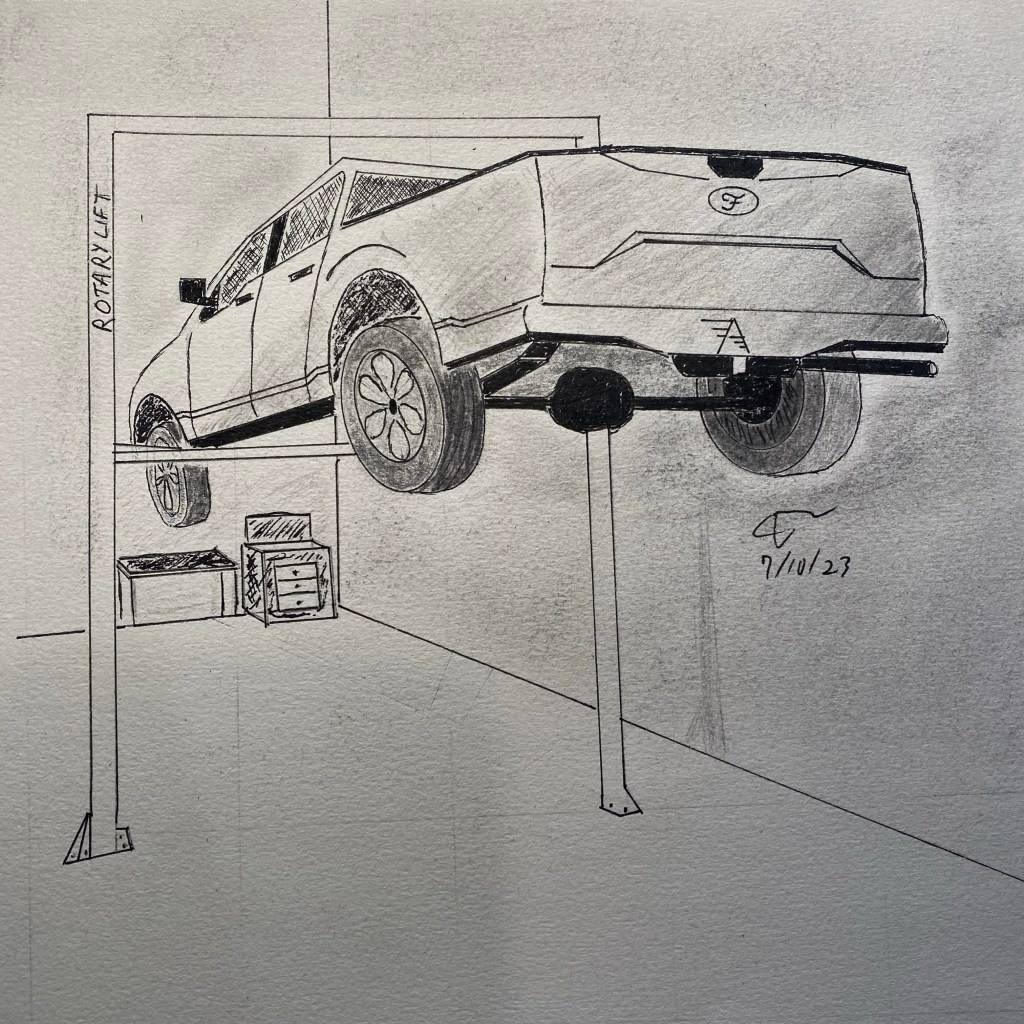
So, why am I thinking about this now, years after the fact? I suppose today’s drawing has something to do with it; I was looking for something with a challenging perspective to draw, and I came across a photo of my pickup truck on a shop lift, taken while I was doing some scheduled maintenance on it. As I was drawing, it occurred to me that the lessons of the car shop formed an interesting analogy for the human body, mind and spirit. And, I must confess, I do love me a good analogy.
The illustration of a corroded and neglected car may not be the most cheerful way to consider the human condition, but it seems to have some traction as an analogy. Like the metal, plastic, fabric and electronic components of a car, the human body and mind are finite; we will all age, decline, and die. This is irrefutable. We cannot change the fact that we will die. We can, however, exercise great influence over how we live. What does that have to do with cars? Consider this: if you were to walk out to your car right now, find the owner’s manual, and flip to the last chapter or two, what would you find? You would likely find a table containing a schedule for the periodic maintenance that your car needs. This is because the car manufacturers are trying to tell you, the owner, that if you want your car to last and perform well over time, it needs scheduled maintenance. It is not true that something similar might be said about people?
We may not come with manuals, but we need maintenance too. What kind of scheduled maintenance do you do for body? How’s your diet? How’s your exercise regimen? How many hours of sleep do you get every night? What kind of scheduled maintenance do you do for mind? When’s the last time you read a book or did something artistic or learned a new skill? Unused skills or capabilities are likely to become “corroded” and lost; as an example, about a decade ago, I learned a new language for my job, and I was able to speak, read, and write it at a fairly high level. But as the years have gone on, I haven’t used the language, and I am sorry to admit that those skills, for me, have corroded. They are mostly gone, because I didn’t maintain them, and they declined over time. And how about your soul? Do you take time for spiritual practices? Or, do you let them slide in favor of whatever busy-ness might seem pressing at the moment?
I hate seeing neglected cars. It seems like such a waste to me to see expensive and well-made machines left to decay. How much more so is it to see a human body, mind, or spirit not being tended to? Just as a car needs regular car, so also do we. If it seems like I write about this sort of thing a lot, it is probably because I think about it a lot. It may be, in part, because of what I do for a living; my schedule is irregular, to say the least, and some level of fatigue is a near-constant companion. Because of this, it would be (and has been at times) easy to neglect taking the time to care for my own body, mind, and spirit in the constant churn of life. However, I have found that these “self-maintenance” practices go a long way towards keeping me grounded, even though I may find myself initially “too tired” or resistant to get in the car to go to the gym or to church, or to pick up a book or my pencils to draw. Which is not to say that it’s not ok to be too tired to do anything and just…rest. That is a valuable form of maintenance too, especially when it seems like the normal in our society is burning the candle at both ends all the time.
So, the next time you go out to your car, take a slow walk around it and take a good look at it. What kind of condition is it in? Is it clean? Have you had that weird rattle or those bald tires looked at? Have you done the scheduled maintenance that it needs? If not, why not? After that, perhaps stand in front of a full-length mirror and ask the same question. What kind of condition is the person in the mirror in? Are you giving yourself the scheduled maintenance that you need? Have you had that painful elbow looked at, or really tried to make meaningful adjustments to your lifestyle so you aren’t so exhausted all the time? While you are at it, perhaps consider a limitation of the analogy presented here; if your car corrodes and decays to the point where it is no longer usable, it can be replaced. The same cannot be said about you – you cannot be replaced; your body and mind cannot be replaced. With that in mind, I hope you’ll join me in considering this as a call to honestly assess how you are taking care of yourself, and perhaps identify one or two small practices in which you might be able to be a little more thoughtful, consistent, or attentive to yourself in the course of daily life. You might be surprised at what you find.
AB7
 Afterburnings