
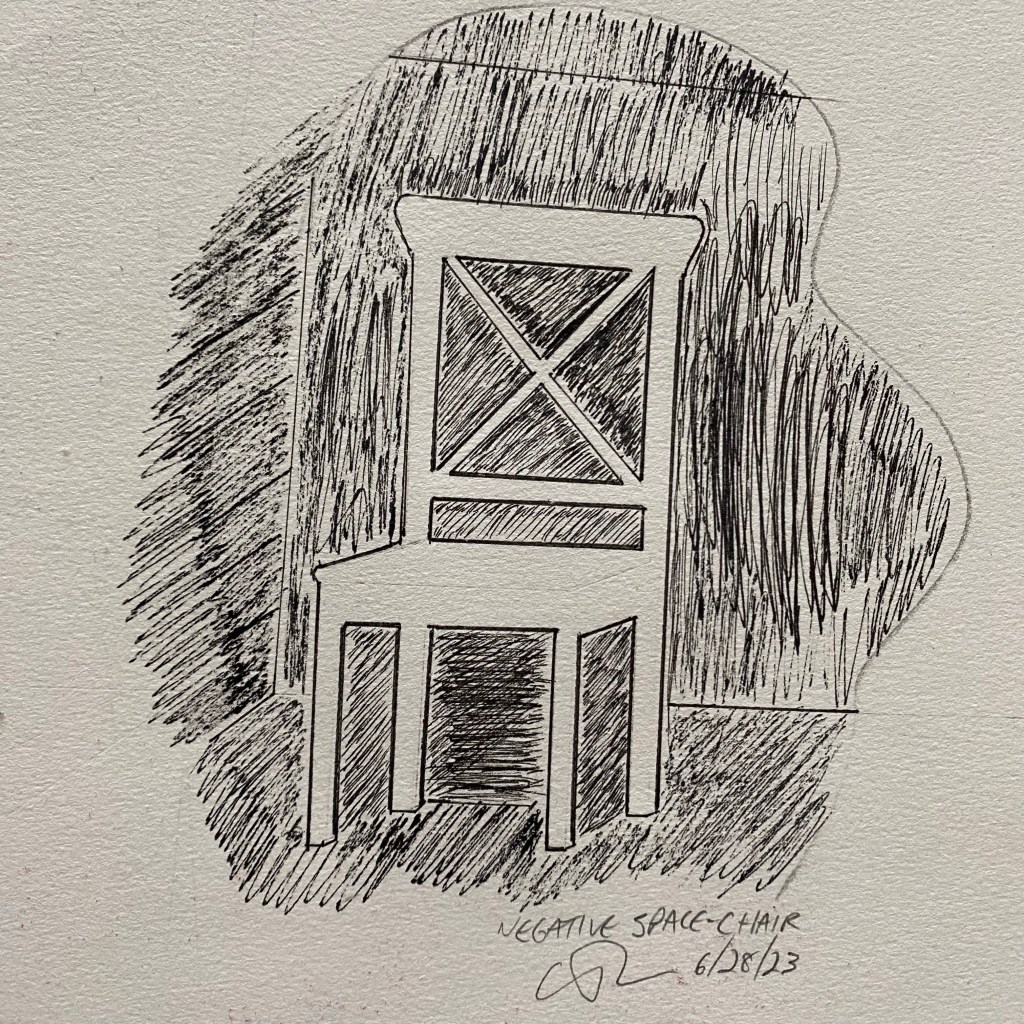
About the drawing: This drawing of one of my dining-room chairs (exciting, right?) is a negative space drawing. Negative space refers to the area around and behind the subject of interest in a work of art. In a negative space drawing, the artist draws the shapes around the object of interest, rather than the object itself. As you can see in this drawing, the chair itself is not drawn; rather, its shape is defined by the shading of the spaces around it. Negative space drawing can be used to create interesting effects in art, and it is also used as an exercise for art students to observe more than just the subject of their drawing. In a way, negative space drawing invites the artist and the observer to shift their view to look at the environment in a way they might not otherwise.
——
One of the constants of life as a professional pilot is…training. Training, training, training. We are always training in one form or another. The aviation industry is marked by an endless stream of policy and rule updates, aircraft updates, changes in procedures, new equipment, and so on. Besides all of that, ongoing training is necessary to maintain proficiency in a wide array of different flying and aircraft management skills that a pilot needs in order to deal with the many contingencies that do or potentially could arise in daily operations. As a result, I have become quite familiar with the expansive training complex at my airline, where I recently found myself for a few days for yet another round of….training.
Our flying training is conducted primarily in advanced full-motion simulators with full-size cockpits and computer-generated visuals. They are realistic to the extent that a pilot can become fully licensed for a commercial aircraft type by flying one of these simulators, with no requirement to fly the actual aircraft itself. Perhaps the most important role of the simulator in airline training is that it can be used to create and practice emergency scenarios in a controlled environment. You want an engine fire? You got it. Out of control deep stall? Check. Wind shear? Bird strike? Instrument failures? Hydraulic fluid leak? Electrical failure? Contaminated fuel? Rapid decompression? Volcano? Zombie attack? Name your mayhem, and it is only a click away. As you might expect, being able to safely practice such scenarios is invaluable (and often challenging) training for pilots.
When I fly the actual aircraft out on the line, I generally show up to work feeling confident, prepared, and ready to deal with whatever situations might arise that day. And why shouldn’t I? I know my airplane, I have a lot of experience, and I’ve successfully navigated my share of scary and/or weird happenings over the years. Furthermore, I have another highly qualified and experienced pilot in the cockpit to help me. I feel like whatever happens, we can handle it, and the vibe is generally positive. When I arrived at the training center for my first day in the simulator, however, a sort of mental shift seemed to happen. I showed up wondering if I prepared enough, wondering if I’d remember all of my emergency procedures, worried that I’d make mistakes…I was not particularly looking forward to the next several hours of simulated pandemonium that I know were coming. The vibe was much less positive, in spite of the fact that I had completed this type of training event successfully countless times before, both in the military and at the airline.
Reflecting on it after the fact, I think I was experiencing a form of negativity bias. Negativity bias, properly, is a cognitive bias that results in negative stimuli having a more significant impact on our psychological state than positive stimuli. In the case of my training, I am extremely grateful for the tremendous amounts of resources that the airline dedicates to giving its aircrews good training. Every time I leave the complex after a training event, I feel like I learned something, and I feel equipped to do my job well. However, in the moment, that gratitude and record of positive results was overshadowed by what I knew would be a mentally taxing and, at times, stressful experience. This is consistent with the findings of many psychological studies like this one[1], which suggest that when a person experiences positive and negative feelings of the same magnitude, the negative is experienced more intensely. In other words, people tend to view events more negatively than the actual sum of their positive and negative parts.
All of this got me to thinking (which happens a lot); does this kind of negativity bias affect me in other areas of my life? Oh yeah. Guilty. For the most part, I consider myself to be a very optimistic person; I always think things will turn out well in the end. At the same, I have moments where I can spiral into a wheel of negativity over one issue or another. Most of us do. What usually gets me out is changing my view point; I find that if I can look at the issue or question in a different way, then some of that negativity begins to dissipate. This, of course, is often easier said than done, and it can also require exercising wisdom over one’s mind and sources of stimuli. What are we feeding our minds with? And where are these negative narratives coming from? For example, I am part of a social media work group that has a lot of good information and resources on operational issues, work rules and the like. It can be very helpful, especially for newer pilots. However, being social media, it sometimes spirals into a space that is very negative and not so helpful. When this happens, I just have to log off for a few days or weeks or months, or those thought patterns might affect me negatively as well. This is just one example of sources of negativity – there are many others. Things like the 24-hour news cycle, the internet, social media, negative people, old experiences that have no bearing on what is happening now, the list goes on.
I am taking this episode of negativity bias in my flight training as a call to examine other areas of my life where such thought patterns might be having an adverse effect on my life, work, and relationships. I have a feeling that this sort of pattern might be lurking in ways that I don’t fully recognize. In a similar way that exploring negative spaces can create interesting art, looking at thought and belief patterns in a different way can yield surprising and fruitful results.
AB5
[1] Kanouse, D. E., & Hanson, L. (1972). Negativity in evaluations. In E. E. Jones, D. E. Kanouse, S. Valins, H. H. Kelley, R. E. Nisbett, & B. Weiner (Eds.), Attribution: Perceiving the causes of behavior. Morristown, NJ: General Learning Press.
 Afterburnings