
The final nudge that pushed me back into the blog-o-sphere came from an unexpected source: my grade- and middle school-aged kids. Watching them do their school work, play games, and use various apps on their tablets and Chromebooks, it’s easy to be impressed by their speed and proficiency on their devices at relatively early ages. However, hand the same kids a pencil and a piece of paper, and a rapid and drastic transformation takes place. These kids, who are like little evil geniuses with their devices, look awkward and uncomfortable when handwriting. Predictably, the results that follow are also in stark contrast to their digital proficiency – none of them have particularly good handwriting.
Now, I’m not trying to pick on my kids; they are all perfectly intelligent and capable of being proficient writers. So…why aren’t they? The simple (and most probable) explanation is because they don’t do it. As I see it, the obvious and glaring contrast between their proficiency on devices and lack thereof at handwriting is not an issue of aptitude, it’s an issue of skill development. They simply don’t write very much. In contrast, they use devices for almost all of their school work, and for a good measure of their recreational time as well. So, it naturally follows that they are good at the skill they develop and use (devices), and not so good at the skill that is developed and used much less (writing). Of course, we limit their time on devices, and we encourage them to write, draw, and do manual tasks and hobbies with their hands. Generally, they are willing and cooperative, but the fact remains that they will learn and grow into adulthood in an increasingly digital and paperless world, which will shape much of their academic skill development.
In a similar way, much of my professional existence has become device-based. When I began flying professionally twenty-plus years ago, flight planning, navigation, performance calculations, and other flight tasks were performed with paper manuals, charts and maps strewn across a large flight planning table. Now, all of those tasks are contained within apps on a tablet – I tap, tap, tap on a few apps, and off I go with everything I need. Like my kids, I’ve become proficient with my tablet, because that’s what I use every day. Quite frankly, I’m glad to have it; it works well, it’s convenient, easy to transport, and it cuts out a lot of paper usage. All good things. At the same time, the consequence is that my proficiency with the old way of doing things is almost certainly not what it used to be. If I had to revert back to the old charts and manuals, I could of course do it, but it would take a bit longer than it did when I did it every day. Applying the analogous scenario to my kids handwriting, it is made even more difficult by the fact that handwriting is something they never did regularly or proficiently in the first place.
If this is beginning to sound like an anti-technology call to go back to the old days of only notebooks, yellow number two pencils and those wall-mounted pencil sharpeners at the front of the classroom, it’s not. I welcome tech that helps us live, work, learn and do our jobs better and more efficiently. I’m glad that my kids are becoming tech savvy at a young age, because those are skills they will need as adults. At the same time, it seems to me that it’s worth intentional effort to stretch and use our brains in different ways. Science seems to support this idea; there are numerous studies (such as this one from the National Library of Medicine[1]) that suggest manual handwriting improves learning retention and disposition in comparison to typing alone. Confronted with this information, I had to ask myself a potentially uncomfortable question – how much do I write? I quickly thought of my notebook/journal that I write in on most days (big-time introvert here, yo), but that is more often than not just jotting a few sentences or ideas. Otherwise, the honest answer was…not that much. Consequently, I concluded that in the same way I encourage my kids to write and stretch their minds in various ways, so should I do the same for myself.
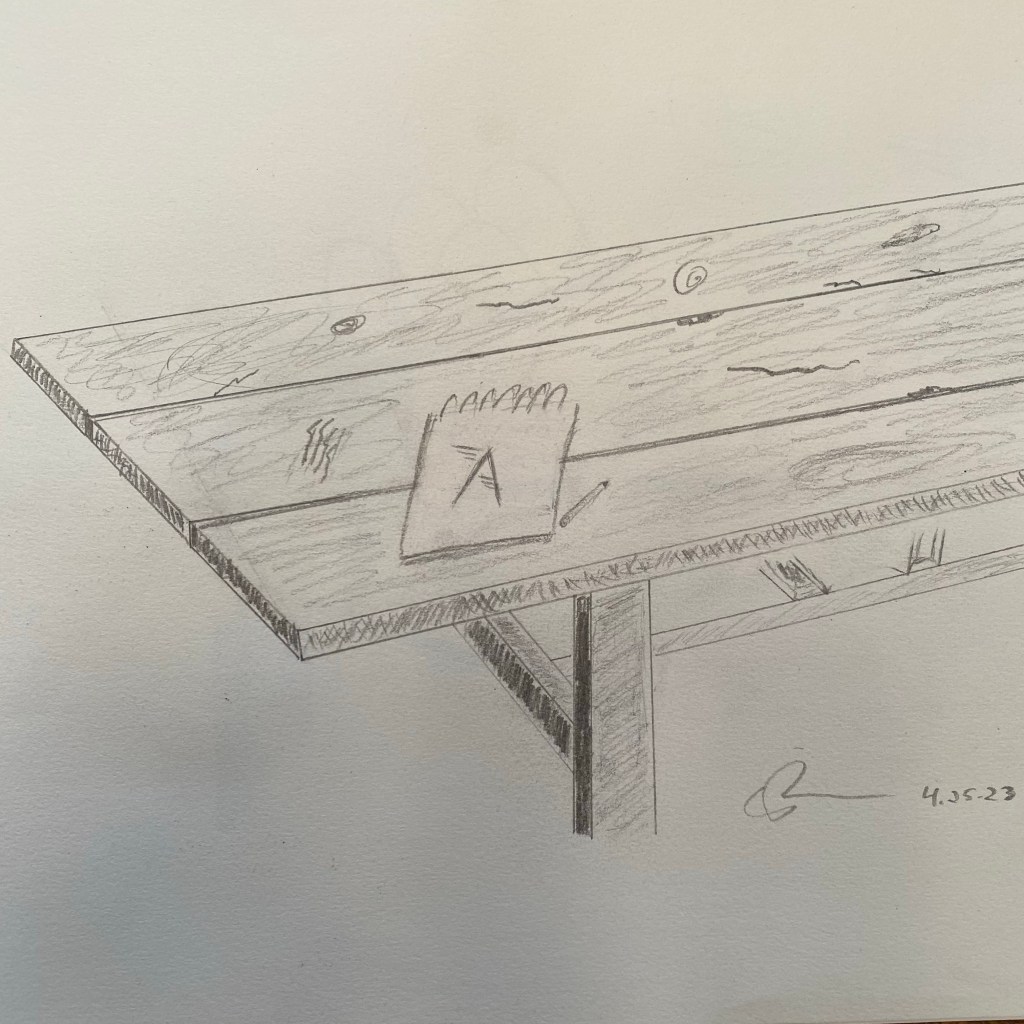
A fair question that might occur to the reader at this point is, how is this facilitated by a web-based electronic blog? For me, it begins by acknowledging that I (like my kids) don’t write that much anymore. So, I decided that each blog post I write will first be hand-written prior to typing up and posting. Similarly, I intend to hand-draw a sketch or picture that will accompany each post (more to follow on drawing in another post). Not that I’m a great or even good artist by any stretch, but I’m learning, and I consider the effort at artistic expression to be a worthy end in itself. Talk to you again soon, and in the meantime, I hope you’ll join me in looking for profitable ways to stretch your mind.
AB1
[1] Ihara AS, Nakajima K, Kake A, Ishimaru K, Osugi K, Naruse Y. Advantage of Handwriting Over Typing on Learning Words: Evidence From an N400 Event-Related Potential Index. Front Hum Neurosci. 2021 Jun 10;15:679191. doi: 10.3389/fnhum.2021.679191. PMID: 34177498; PMCID: PMC8222525.
 Afterburnings